
Robbie Pennoyer Debuts Teaching with Grace
Head of School Robbie Pennoyer began September’s PA meeting recounting his favorite email from the opening week of school.
In it, a parent described observing their middle schooler in the play yard with four or five classmates before the start of the school day. The children’s heads were down as they stared, mesmerized, at something in one boy’s hands. Believing that they must be looking at their phones, the parent thought, “I guess they can’t take away their devices before the school day officially begins.” A few seconds later, it became clear that the children were looking at a deck of cards, and the exclamations of “No way!” and “How cool!” were elicited by a magic trick the boy had just performed.
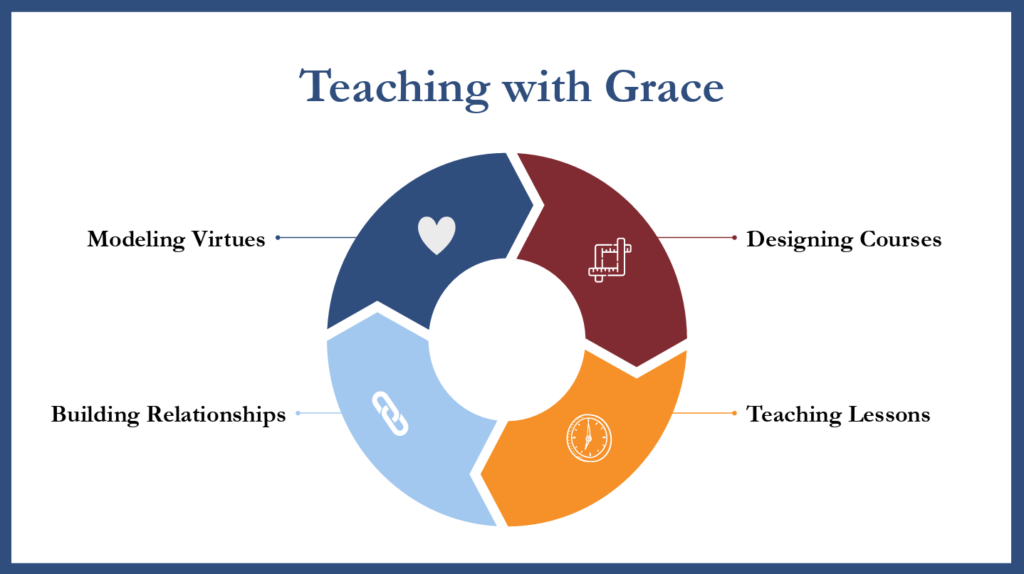
After sharing this sweet moment, Robbie took parents on a photographic tour of Grace’s refreshed spaces (more on that below) before introducing Teaching with Grace. This new framework provides common language for describing teaching excellence at Grace and the ways our educators create a learning environment characterized by effortful thinking, joyful learning, and deep belonging.
Teaching with Grace emphasizes four key, interdependent components: designing courses with clearly defined goals for what students will know—and will know how to do; teaching lessons that align with the larger aims of the course; building relationships that inform teachers’ understanding of each student’s unique needs and talents and how to help them flourish; and modeling virtues such as kindness, curiosity, humility, and courage. Each of these aspects of teaching depends upon and deepens the others. Thoughtful, intentional course design achieves learning goals through lessons that resonate with students and generate effortful thinking; effective teaching provides constant opportunities to model virtues; and values are most powerfully taught when done so in the context of relationships based upon trust and respect. Through Teaching with Grace, educators have a roadmap for making good on the high aspirations of our mission.
Robbie then turned to a topic on everyone’s mind: AI. He described how the new Teaching with Grace framework is being used to shape the questions we are asking as we navigate this new technology, as well as how it will inform our answers. One area of much interest—and concern—is how AI will affect students’ ability to engage in effortful thinking, a hallmark of our program, deeply embedded in our mission. AI can be an off-ramp to the kind of critical thinking and discernment that will be necessary in order to engage with these tools effectively, Robbie shared; it can also expand the reach of our abilities in ways that we are only beginning to fathom. Where technology risks impeding critical thinking or diminishing the intellectual, social, or emotional wellbeing of our students, the School is exercising discernment and restraint. Where it aligns with our mission and enhances our ability to help students develop skills of intellectual excellence and habits of ethical virtue, it will be thoughtfully integrated.
To ensure we are asking the right questions as we embark on the next phase of this work, the School will draw on expertise from the community. Robbie announced the formation of an AI Task Force, which will bring members of the community who have industry expertise together with faculty and staff to act as a sounding board and advisory council for the School. This body’s insights will complement the work happening across the school among faculty in the AI working group and across grades and departments.
Whatever the challenges ahead, from AI or other forces, Grace is supremely well positioned to respond, finding steadiness and clarity in the values and commitments of our mission. He closed with inspiration in the work ahead, beautifully articulated by Harvey Lederman in “ChatGPT and the Meaning of Life”: “There is at least one job that no machine can take away: the work of self-fashioning, the task of becoming and being ourselves. … Creating this work of art could give some of us something more to live for.”