
 Academics
Community / Chapel & Episcopal Values
Since its founding, Grace Church School has understood intellectual excellence and ethical virtue to be mutually dependent. We attend to the moral, personal, and spiritual development of our students as intentionally as we cultivate their intellectual growth. We believe that curiosity, creativity, and critical thinking develop best when joined with humility, kindness, courage, and a sense of responsibility for others.
We are an intentionally inclusive community where reverence for the dignity of each individual informs all aspects of school life. The Episcopal school tradition recognizes the unique, intrinsic worth of every human being, bestowed upon each by a loving God. In this spirit, we welcome, openly and with warmth, families of all faiths and no faith at all. We seek out a rich diversity of students, families, faculty and staff, and strive to instill in our students a deep respect for differences in race, religion, sexual orientation, gender identity, socioeconomic status, ethnicity and culture. Our expectation is that Grace Church School students and community members will pursue these ideals, honoring our common humanity with kindness, respect, and love and striving to build lives of genuine meaning, purpose, and service.
Episcopal tradition is the pillar on which our inclusive welcome and promise of educational parity rest. Our school commitment to diversity affirms, “. . . that participation in an inclusive school culture . . . plants the seeds for positive contributions to a world in which fear and conflict may otherwise threaten to create a false sense of belonging through exclusion.” Our anti-bias and antiracism programs, in which students explore the meaning of an inclusive and just society, pave the way for our graduates to embrace ethical responsibility in a participatory democracy.
The School’s Episcopal tradition lies at the heart of a long history of community connection and service for the greater good. Whether working on behalf of relief from disaster or displacement, the environment, or justice and equity, Grace Church School students, parents, faculty, and alumni are active members of a “community that serves.”
CHAPEL
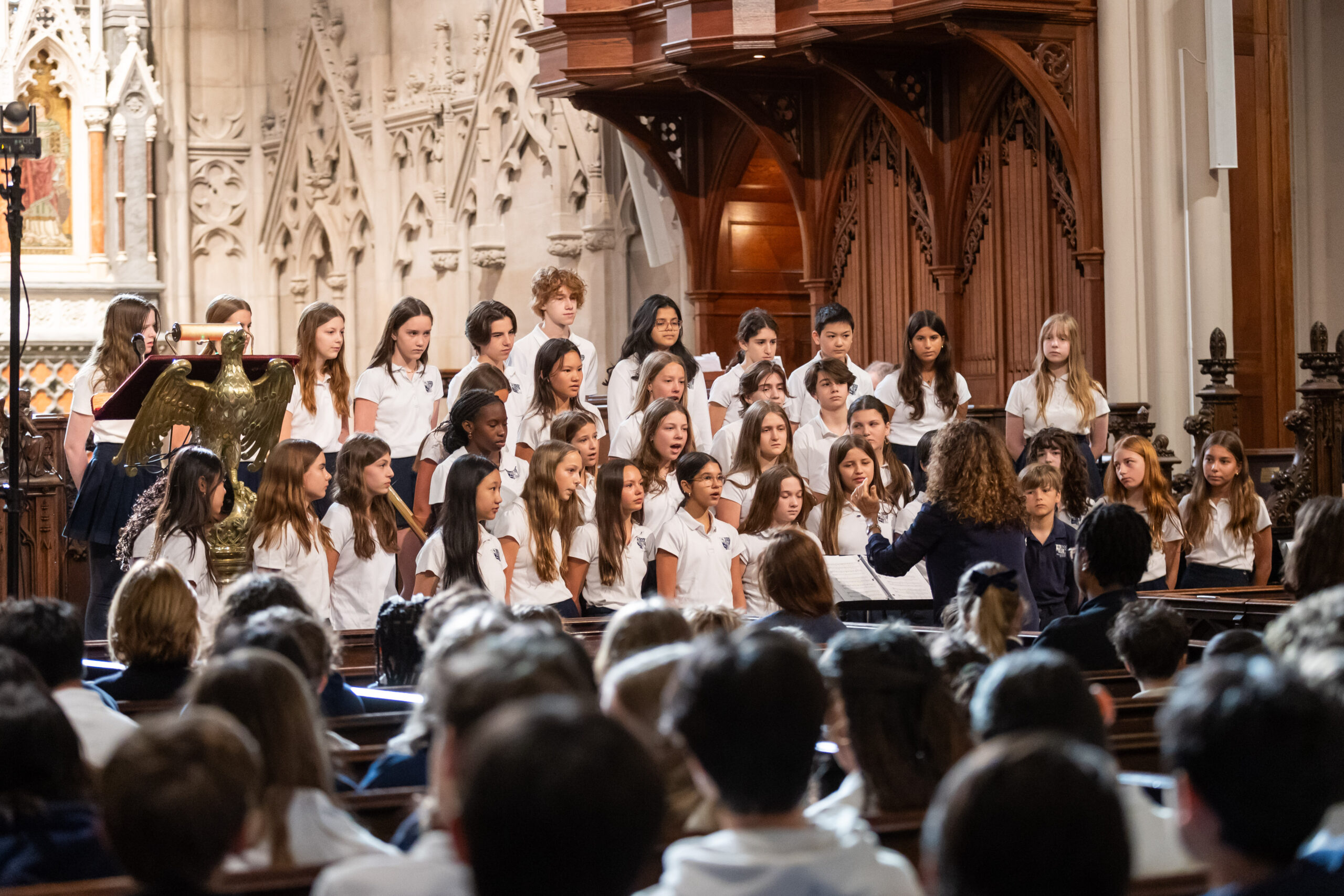
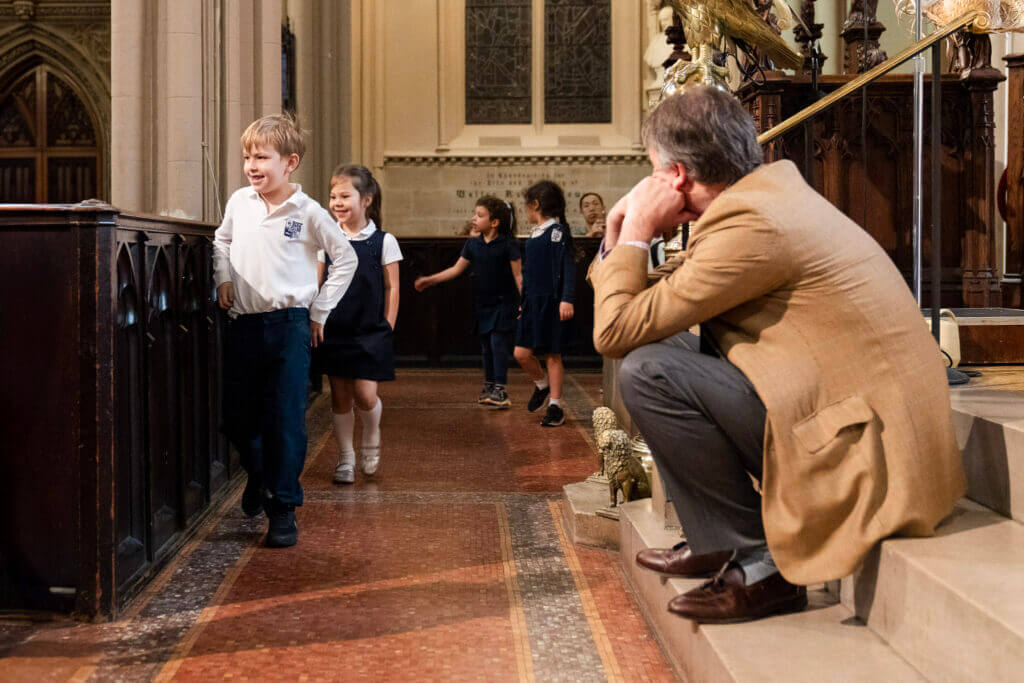
The Chapel program is an extension of the school’s mission to celebrate and honor the dignity of every human being, welcoming equally those of all religious backgrounds and those with no faith tradition. Students are not asked to diverge from their personal or family beliefs, but rather to reflect on them more deeply. Chapel exposes all present to the beauty and transcendence that lie beyond the commonplace and the everyday. The physical grace and beauty embodied in the architecture of Grace Church, and the ethical steadiness nourished by the School’s Episcopal tradition, provide both a powerful counterpoint to the concentrated energy of the city, and a strong spiritual and ethical compass, for students from junior kindergarten through grade 12. Chapel provides a space apart, a still point in the day where all may slow down, reflect, relax, think, feel or pray, and a central gathering place for the entire school community.
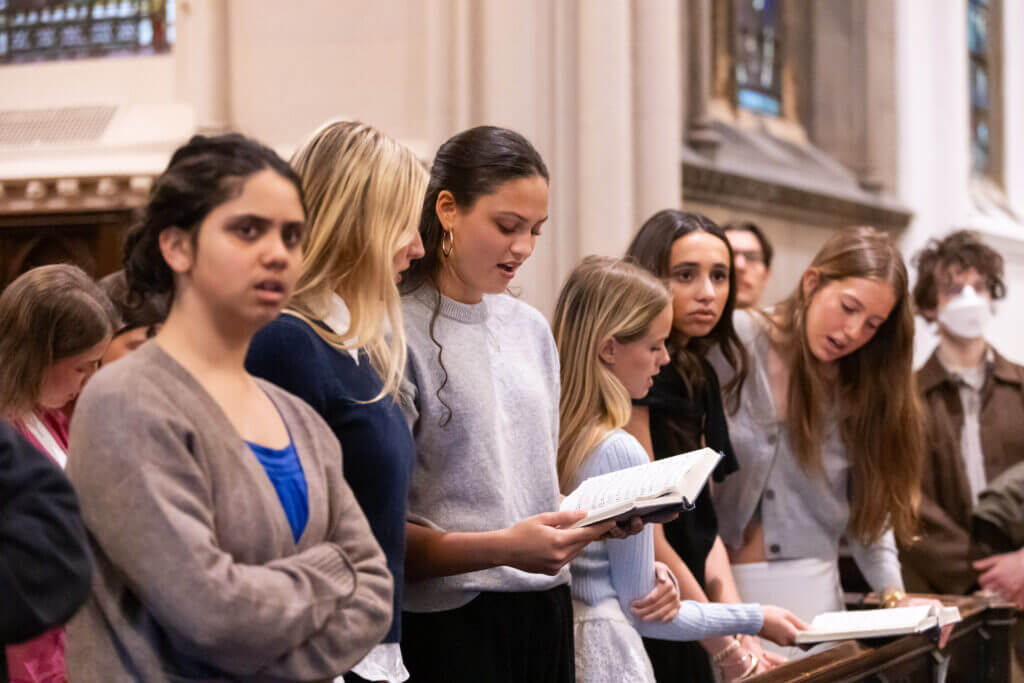
Junior kindergarten through eighth grade students attend chapel once a week, while high school students attend chapel once every other week, alternating with community meetings. Chapel is a creative, inclusive time of gathering that draws upon the liturgical resources of the Episcopal Church and is a regular part of school life for all members of the Grace community. In addition to readings from the Hebrew Scriptures and the New Testament, there are also readings from the world of sacred traditions and literary texts. Each chapel includes reflections from members of the Grace community, meditations shared for the world, an invitation to the Lord’s Prayer, and the music of hymn and song.
Chapel talks are built around a range of topics; they may address ethical issues or social justice themes (such as an annual Martin Luther King Peace Chapel) or be used to mark the holy days of a diverse list of faith traditions. Students, staff, and faculty are invited to reflect on philosophical questions about human existence, the meaning behind various world religious traditions, and the complexities involved in developing ethical and moral leadership.
Storytelling is at the root of Early Childhood Chapel. These weekly gatherings focus on ethics and values, and include prayers written by the children. Lower School chapel is organized around the ten key virtues that center Lower School life: respect, citizenship, responsibility, kindness, courage, honesty, generosity, harmony, empathy and grace. Middle School and High School chapel involves student participation in music, reflections, readings, and prayers. Families are welcome to join Early Childhood and Lower School chapels. In addition, there are four all-school chapels per year, which are typically livestreamed for families.
Finally, Chapel offers a sacred space to reflect or seek peace in both joyous and challenging times. Chapel gatherings may mark a local, national or international crisis; a loss in the community; or any event that inspires people to gather together. At these times, the sanctuary of Grace Church grows as a source of comfort to the entire school community, providing a place for all to find both personal and shared solace in Chapel’s collective experience.
THE SCHOOL CHAPLAIN
Chapel services are led by the School’s chaplain. The chaplain, an ordained Episcopal priest, holds a Masters of Divinity and Ordination as well as a degree in counseling. In addition to presiding over Chapel, the chaplain serves on the School’s administrative leadership team. The chaplain is a full-time member of the faculty, teaching courses in the department of Philosophy and Religion and leading student groups focused on service learning, equity, inclusion, and belonging.
The chaplain provides crucial leadership in times of crisis, serves as a resource for all members of the Grace Church School community in times of personal or community need, and functions as a bridge between the School and Grace Church.
The School is a member of the National Association of Episcopal Schools (NAES). The chaplain represents the School at the NAES conference, webinars and local Episcopal and interfaith forums.
For further information about chapel services at GCS, or the role of the chaplain at Grace Church School, please contact the chaplain at swood@gcschool.org. All questions are welcome.
The Religion and Ethics curriculum at Grace Church School deepens and enhances students’ grasp of recurring themes in history, literature, philosophy, social movements and culture. We teach about all religions, affirming and welcoming the diverse faith and ethical belief systems of our families, while recognizing that a curriculum covering Hebrew scriptures, the New Testament and sacred texts of other faith traditions is fundamental to a thorough education.
Religion holds a solid place in the complement of JK–12 studies at Grace Church School. GCS teaches about all religions in ways that make students and families of all faiths feel welcomed and affirmed, with an interdisciplinary approach that includes both specific, dedicated religion courses and integration with units of study in other departments such as English and history.
Students in JK–2 experience the study of religion and values through chapel. JK and K students also learn about prayer and what it is to pray, with regular discussions that are then incorporated into the chapel program.
Third, fourth and fifth graders take Bible class, which meets once a cycle all year in grades three and four, and for a half year in grade five. The third and fourth grades read Hebrew scriptures, and the fifth grade focuses on the New Testament. These sacred texts are taught neither as truth nor as literature. Rather, they are presented as a body of powerful stories that have moved millions over thousands of years and serve as truth to those for whom they are true.
In sixth through eighth grade, the study of religion is integrated into several existing programs—notably history units in world cultures. Ethics and ethical decision making are addressed as part of the Character Education program in Middle School grades. Additionally, eighth graders complete a ten week special project, the “Worldview Paper,” a five to eight page research paper exploring a specific aspect of each student’s own personal ethics, beliefs, or values.
The High School program includes a combination of required and elective courses in philosophy and religion. The courses focus not only on descriptions of various religions and belief systems, but they also engage students in discussion and reflection on fundamental questions posed by the great philosophical and religious thinkers of the ages. Students examine traditions and beliefs outside their own that broaden and deepen their understanding of the world spiritually, philosophically and practically. All ninth and tenth grade students take a weekly Philosophy & Religion course. The ninth grade course surveys the world’s religions; the tenth grade course offers a survey of major thinkers and philosophies. The eleventh and twelfth graders are required to take a semester elective in religion, ethics, comparative religion, philosophy, or psychology.
“We gather each week for Chapel, providing a sacred space that honors the worth and dignity of every member of our community. Moments in Chapel remind us of the countless ways we are all connected. We remember the parts we play, attentive to the cares and needs of this world. Each person makes a unique and irreplaceable difference. Through our practices in Chapel, we as Grace grow more fully in heart and mind as a beloved community.”
The Rev. Sarah Wood, Chaplain