PROGRAMS / Middle SChool
Minds in Motion
The middle school curriculum offers academic rigor, breadth of opportunity, and a community that helps students turn the challenges of early adolescence into genuine growth.
Reading as Encounter, Writing as Thinking
English in the Middle School is designed to develop students who are not just capable readers and writers, but genuinely curious ones—readers who notice how language works and writers who understand that clarity, precision, and voice are skills worth cultivating.
Across fifth through eighth grade, the curriculum grows in sophistication and demand, moving from foundational literary analysis and structured writing in fifth grade, through increasingly complex essay work and creative forms in sixth and seventh, to eighth grade, where students engage with challenging texts from multiple perspectives and craft both analytical and imaginative writing with confidence and nuance. Throughout, the emphasis is on reading as a means of encounter—with ideas, with other lives, with the world—and on writing as a means of thinking. In seventh and eighth grade, students are encouraged to push further and elect one of three writing-intensive seminars—Worlds of Knowledge, Global Culture and Society, or World Writers—each of which immerses students in a rich range of texts, cultures, and ideas while developing their critical thinking, close reading, and expressive writing at an advanced level.
Exploring Connections Between Past and Present
History in the Middle School asks students to do more than learn what happened—it asks them to think like historians: to evaluate sources, construct arguments, and draw connections between the past and the present.
In fifth grade, students take a sweeping look at human history through the lens of Yuval Noah Harari’s Sapiens, examining what it means to be human and how civilizations have shaped one another across time. Sixth graders focus on American history from pre-Columbian civilizations through the Revolution, developing research and essay-writing skills through projects that culminate in formal presentations. Seventh graders continue through American history from the early republic to the end of the nineteenth century, while eighth graders examine the twentieth century and its global consequences, from imperialism through the Cold War to the present day.
A through-line across sixth, seventh, and eighth grade is the E. Allison Grant Memorial Essay Prize, awarded annually at graduation to the student whose research essay is judged best by a panel of history and English teachers—a reminder that rigorous historical thinking and strong writing are, at Grace, inseparable.
The middle school curriculum asks students to do more than absorb information. It asks them to think like historians, write like authors, reason like mathematicians, and investigate like scientists.
By the time students leave eighth grade, they have written research essays, designed scientific investigations, and wrestled with some of the biggest questions in human history. They are ready for what comes next, and they know it.
Understanding Why, Not Just How
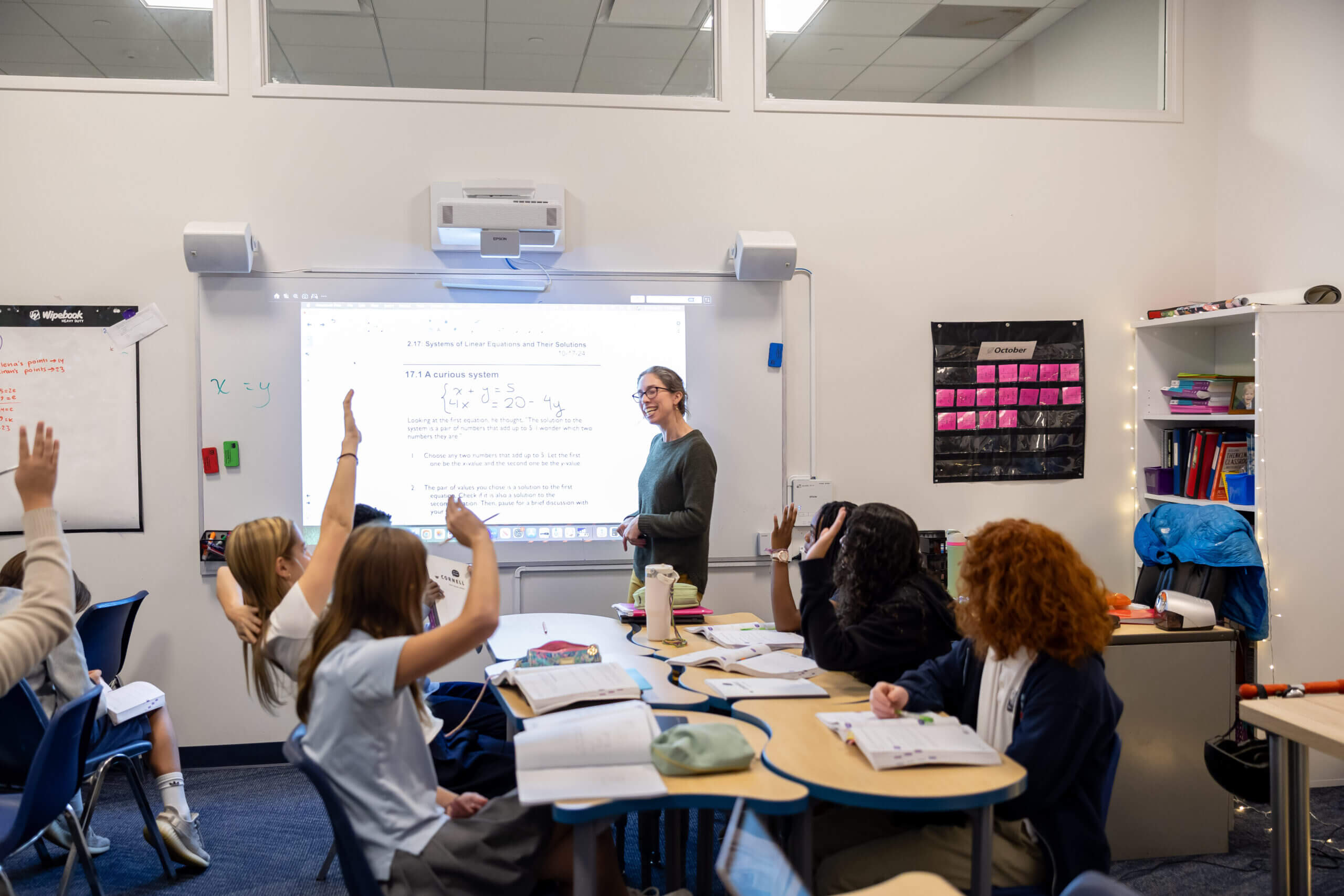
Mathematics in the Middle School is designed to build not just competence but genuine mathematical confidence—the kind that comes from understanding why something works, not just how to do it.
In fifth and sixth grade, students deepen their numeracy through problem-based learning, developing fluency with fractions, decimals, ratios, proportional relationships, and the foundations of algebraic thinking. Seventh graders extend this work into rational numbers, algebraic expressions, equations, and the study of linear relationships. Eighth graders complete a full course in Algebra I, mastering systems of equations, functions, exponential and quadratic functions, and the Pythagorean Theorem—leaving the Middle School fully prepared for the more advanced mathematics ahead.
Science as Practice
Science in the Middle School is built around a single animating idea: that students learn science best by doing it. From fifth grade onward, the curriculum emphasizes hands-on experimentation, careful observation, and the habits of mind that define scientific thinking—asking good questions, designing investigations, interpreting results, and drawing conclusions with intellectual honesty.
Fifth graders explore science at its broadest scale, studying marine science, human physiology, and astronomy—moving from the cellular to the cosmic. Sixth graders shift their focus to chemistry and physics, investigating matter and its changes, the periodic table, electricity, and magnetism through a rigorous laboratory approach. Seventh graders turn to life science, examining cell biology, genetics, heredity, human body systems, and ecology—culminating in an independent research project of each student’s own design. Eighth graders return to chemistry and physics at a more advanced level, developing both concrete and abstract critical thinking skills as they study atomic structure, chemical reactions, Newton’s laws, waves, and optics. In May, seventh and eighth graders present their independent research projects at the school’s annual Science Fair—one of the Middle School’s most distinctive traditions, and one of the most vivid expressions of the independence and intellectual ambition Grace cultivates across the middle school years.
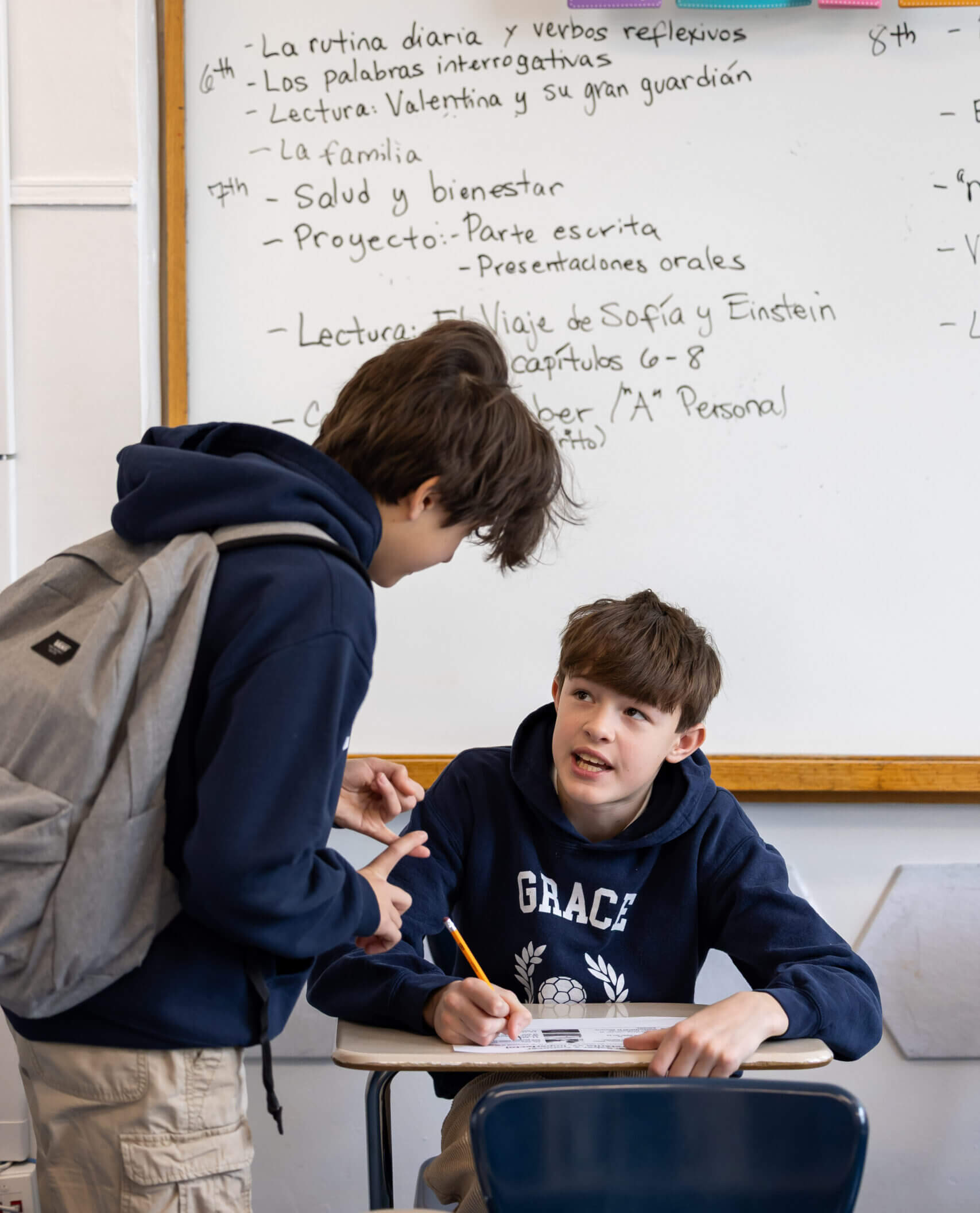
Growing Into a Language
World languages in the Middle School builds on the foundation established in the Lower School, deepening students’ proficiency and expanding their engagement with the cultures of the Spanish- and French-speaking worlds. In fifth grade, students continue developing vocabulary and conversational skills, with an emphasis on full immersion in the target language from the first day of class. Across sixth, seventh, and eighth grade, the focus shifts progressively from spoken fluency toward more complex grammatical structures, reading comprehension, and active written expression. By eighth grade, students are engaging with authentic texts, conducting oral presentations, and using language as a genuine tool for communication and deeper cultural understanding.