

Fletcher K. ’26 Explores Architecture of Grace Church
An integral part of the Grace high school experience is Independent Project 10 (IP10):
a yearlong, in-depth study on a student’s topic of choice, on which they carry out research for most of sophomore year. This project allows students to identify and explore areas of interest, diving into independent research, drawing from experts in the community, and pushing themselves to design and execute their projects with the support and encouragement of faculty, staff, alumni, and parents. It culminates in an evening symposium, during which students present the results of their hard work and discovery to a delighted audience of friends, family, teachers, and staff.
Although IP10 officially concludes with the symposium, for many students, the experience serves as a springboard for ongoing passion and discovery.
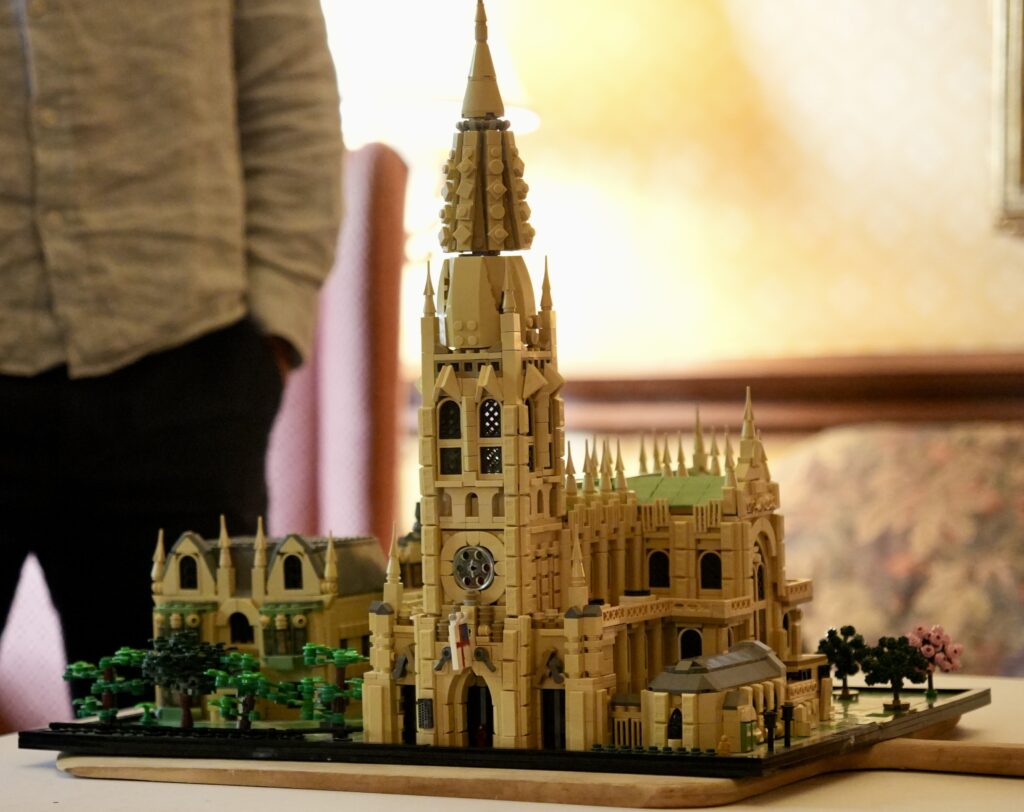
Two years ago, Dean Chan tasked the Class of 2026 to “take something you love and really go for it.” Hearing these words, Fletcher K. ’26 pondered his passions—he liked Star Wars, architecture, the class he was taking with Mr. Root (Dante’s Divine Comedy), and Lego. Ultimately, these interests coalesced and a project idea emerged: he would construct a scale model of Grace Church, in Lego, where he’d spent the past several years attending Chapel.
One day, as he was taking photos of the Church’s exterior to inform his 3D design, he was approached by the Reverend Harry Krauss. A mentorship blossomed, and Fletcher’s project evolved into one that explored not just the architectural elements of the Church, but also the history that informed its construction, contextualized by extensive archival research. Spending weekends and after-school hours digging through Grace Church’s archives with Mr. Krauss, Fletcher was able to understand each element of the Church he was recreating, adding new meaning and importance to the ways in which he chose to portray it. Limited by Lego but emboldened by his desire to honor history, Fletcher had to make difficult choices about which elements were most important to uphold, balancing the obstacles of accuracy, structural integrity, and feasibility. It was particularly rewarding, he shared, when he could find ways to replicate a certain cornice or scaffold—but equally discouraging when he was forced to improvise on elements that lacked a workable Lego counterpart: the spire, notably, represented by a Lego sword.
Fletcher quickly became consumed by his deep interest and passion for the project. In reflecting on the final product, he acknowledged that, knowing what he knows now, he “could have built the final structure in less than half the time.” But more importantly, he learned the value of an independent project and pursuing one’s passion with rigor, reflecting on the degree to which “something you love can bring meaning to your day.” Whether in the digital building tool, reading one of the Reverend Krauss’s many book suggestions, sourcing pieces from around the world, or scrupulously assembling the structure, Fletcher would get lost in the process, in the best possible way. This, he shared, was something he hadn’t experienced before IP10, and it fueled his desire to go even further with the project.
Fletcher’s IP10 symposium display was only the first iteration of his Lego construction project. Since March of 2023, he has continued to develop the model by researching the history and architecture of Grace Church and experimenting with new building and design techniques. The current version of the project incorporates more architectural details than the original, bringing an already remarkable model ever closer to mirroring the details of the Church’s architecture. What’s more, the experience ignited Fletcher’s passion for historical research. He spent this past summer interning at the Merchant Housing as a writer and archivist, and he hopes to do much of the same in college and beyond.
Visitors are welcome to view the current iteration of Fletcher’s project on display in Grace Church.