
 Academics
PROGRAMS / High SChool
Minds at the Frontier
At Grace, the high school academic program is built around a simple but purposeful idea: that ninth and tenth grade exist to establish a strong, broad foundation across every major discipline, and that eleventh and twelfth grade exist to go deeper into the areas that matter most to each student, with the independence and rigor that serious academic work demands.
Close Reading, Earned Arguments
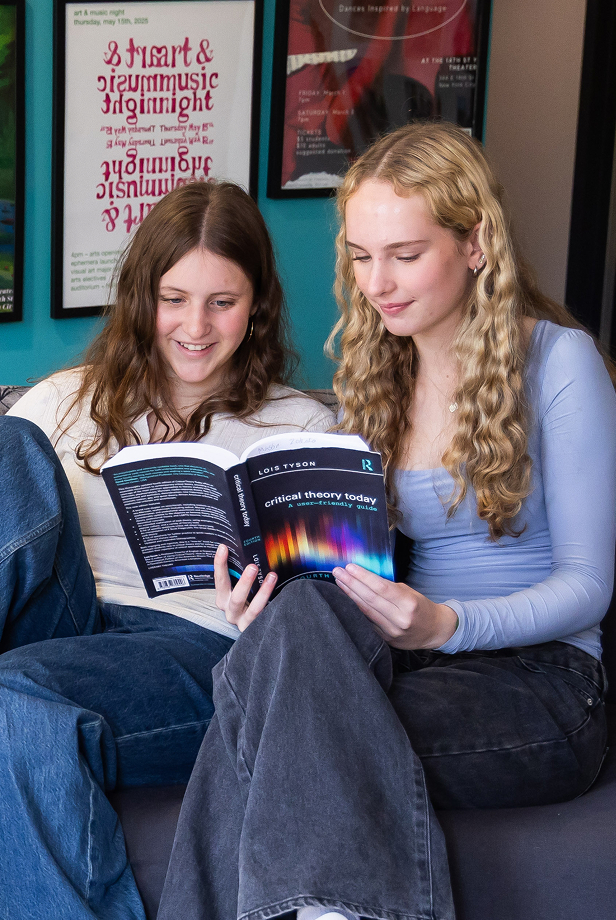
Literature at Grace is taught as an act of encounter—with other lives, other times, other ways of understanding the world—and as a discipline that demands careful reading, precise thinking, and writing that earns its argument.
In ninth grade, students read classic texts from around the world in World Literature, exploring themes of heroism, suffering, and love through works that include The Iliad, The Odyssey, Things Fall Apart, Othello, and Gilgamesh. In tenth grade, Literature of the Americas moves from the United States through Latin America and the Caribbean, with authors including F. Scott Fitzgerald, Gabriel García Márquez, Maya Angelou, and Gwendolyn Brooks. In eleventh and twelfth grade, students choose from a rich and rotating menu of semester-long electives ranging from Dante’s Divine Comedy and Queer Literature to Ghost Stories of the Global South and Science in Literature, allowing them to pursue particular literary passions in depth. Students who demonstrate exceptional aptitude may apply to the Senior Seminar in Literature, a capstone course in independent inquiry that culminates in a 25-page thesis paper and a public presentation in May.
Context, Connection, and Original Thinking
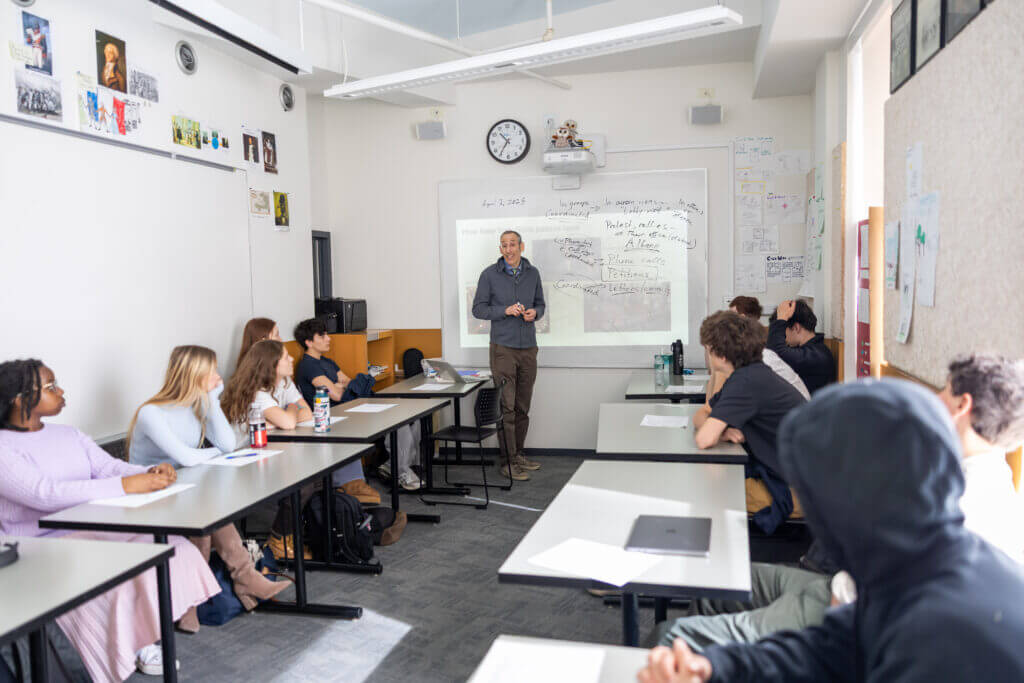
History at Grace teaches students to think like historians: to evaluate sources, construct arguments, and draw connections between the past and the present.
In ninth grade, World History traces the development of human societies from Africa through Asia and Europe, from the origins of agriculture to the age of industrialization and decolonization. In tenth grade, History of the Americas examines the shared history of North America, South America, and the Caribbean, from indigenous societies through colonization, revolution, and nation-building, culminating in a major independent research project. In eleventh and twelfth grade, students choose from a wide range of electives that include Latin American History, Black American Political Movements, The Decline of Democracy and the Rise of Authoritarian Populism, and History of New York City, among many others. Students who demonstrate exceptional aptitude may apply to the Senior Seminar in History, which culminates in a 25-page independent research paper and a public presentation in May.
Persistence, Creativity, and Mathematical Mastery
Mathematics at Grace is designed to develop not just competence but genuine mathematical confidence: the conviction that complex problems are worth attempting and that persistence and creativity are mathematical virtues.
In ninth grade, most students take Geometry, building their understanding of two- and three-dimensional space through inquiry, proof, and algebraic reasoning. By tenth grade, Algebra II & Trigonometry deepens students’ understanding of functions, equations, and the mathematical tools needed for higher-level study. In eleventh and twelfth grade, students choose between two pathways: Pure Mathematics, which leads through Precalculus, Calculus, and, for the most advanced students, Calculus II & Multivariable Calculus; and Applied Mathematics, which leads through Data Science I and II, developing statistical reasoning, probability, and programming skills using Python. Both pathways are taught at standard and intensive levels, and both are designed to equip students for the quantitative demands of college and beyond.
Whether analyzing Dante, designing a quantitative research project, or engaging in self-reflection through the work of Epictetus, students wrestle with the same core questions: What do I think? Why does it matter? What will I do with it?
Grace graduates go on to leading colleges and universities not because they were prepared for admissions, but because they were prepared for what comes after. That distinction shapes everything about how we teach.

Science as Living Knowledge
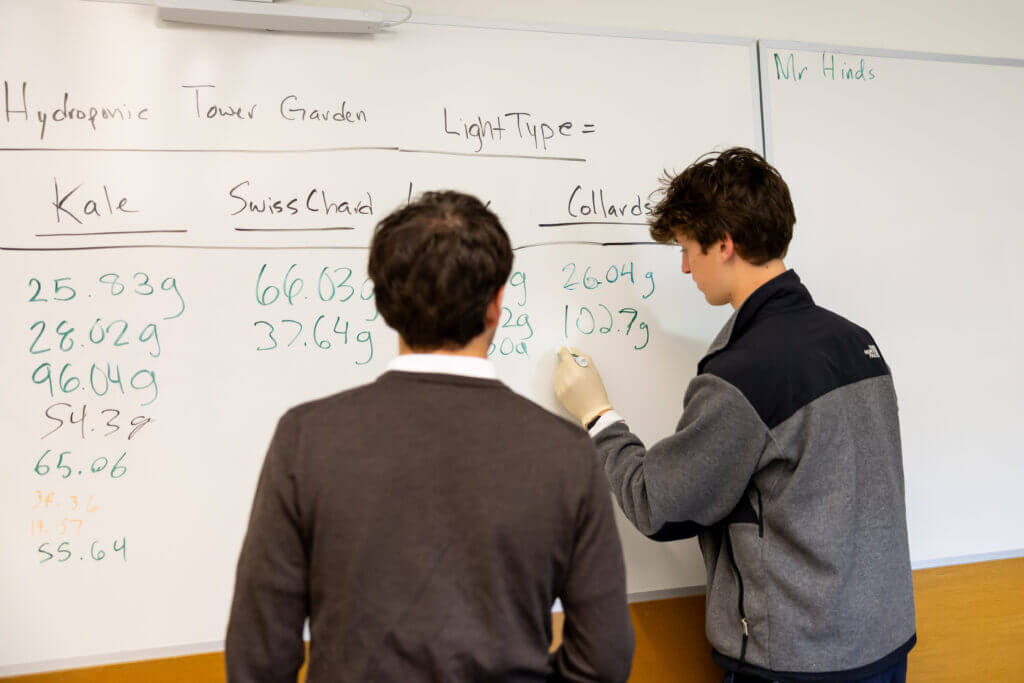
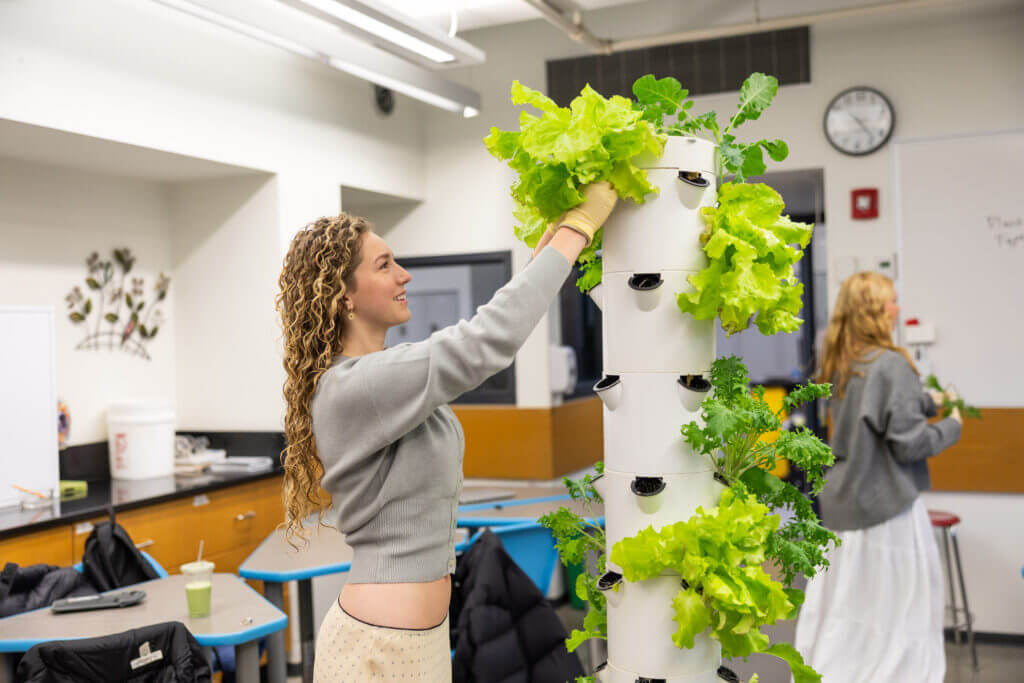
Science at Grace is taught as a process of inquiry, inspiring students to learn not just what is known but how we come to know it and how scientific understanding evolves in response to new evidence.
In ninth grade, Biology examines living organisms, ecosystems, and the molecular machinery of life. In tenth grade, Chemistry explores atomic structure, chemical reactions, and the behavior of matter. In eleventh grade, most students take Physics, developing mathematical models for understanding motion, force, and energy. Advanced Topics courses in Biology, Chemistry, and Physics are available to students who wish to go deeper, and in twelfth grade, students may elect from a range of courses including Oceanography, Human Evolution and Ecology, DNA Barcoding and Bioinformatics, and Environmental Science. Science electives including Neuroscience, Biodesign, Engineering, and Experimental Research Methods allow students to pursue applied science beyond their major course load; the Biodesign course, developed in partnership with an international biotechnology challenge organization, gives students the opportunity to showcase their work at a summit hosted at MoMA in June.
World languages at Grace, which include French, Spanish, Mandarin Chinese, and Latin, are taught as living disciplines: not just systems of grammar and vocabulary to be mastered, but windows into cultures, histories, and ways of understanding the world that differ from our own. Students are required to study one language continuously from ninth through eleventh grade, with 80-minute classes designed for immersion and active use from the first day. In the earlier levels, the emphasis is on building communicative fluency—speaking, listening, reading, and writing with growing spontaneity and accuracy. In the advanced levels, students of French, Spanish, and Mandarin engage with literature, film, and contemporary media from the cultures they are studying, while advanced Latin students read Virgil, Ovid, and Horace in the original, tracing the influence of Roman literature on Western culture across the centuries.
The Practice of Questioning
Philosophy & Religion at Grace invites students to grapple with the fundamental questions of human existence—of value, meaning, purpose, and belief—through careful reading, rigorous discussion, and serious writing.
In ninth grade, World Religions examines the beliefs, practices, and sacred texts of the five major world religions, including visits to houses of worship for each tradition. In tenth grade, Introduction to Philosophy traces the history of philosophical inquiry from ancient Greece through the modern era, engaging students with questions involving ethics, epistemology, and metaphysics. In eleventh and twelfth grade, students choose from electives including Existentialism, Stoic Philosophy, The Bible, Philosophy of Mind and Consciousness, and Theories & Philosophies of Education, each of which invites students to bring rigorous philosophical thinking to bear on questions that remain urgently alive in the world today.
Grace does not offer Advanced Placement courses. This is a deliberate decision that reflects our belief that the best high school education is one designed around genuine intellectual depth rather than standardized exam preparation. Colleges evaluate applicants in the context of the offerings of each school, and Grace’s graduates are admitted to leading colleges and universities on the strength of a rigorous, thoughtfully designed curriculum that prepares them to do advanced academic work.